support@dragon-dealz.com
 +1 (888) 303-8337









Introduction – Why Amazon Organic Ranking Is the Goal Every Seller Should Chase

Every seller on Amazon starts by paying for visibility. Ads put your product in front of buyers while your listing is new and your sales history is thin. But the sellers building real, scalable businesses on Amazon aren’t just running ads forever; they’re earning organic positions that bring in sales without a cost-per-click attached to every order.
Organic ranking is where your product appears in Amazon’s search results without paid placement. It’s the position Amazon assigns your listing based on how relevant, trusted, and high-converting your product is for a given search query.
Over 70% of Amazon shoppers never scroll past page one, and the top three organic results capture more than 60% of all clicks. If your product isn’t ranking organically in that territory, you’re leaving a significant portion of your potential revenue on the table and paying ads to cover a gap that a strong organic strategy would close permanently.
Key reasons organic ranking matters more than most sellers realize:
- Organic clicks carry no per-click cost, directly improving your profit margin on every sale
- Organic positions compound over time; higher ranking drives more sales, which drives higher ranking
- Buyers perceive top organic results as more credible than sponsored placements
- A strong organic position reduces your total dependence on the advertising budget to stay visible
What Is Organic Ranking on Amazon?
Amazon organic ranking is your product’s natural position in Amazon’s search results for a specific keyword, earned through performance signals rather than paid placement. When a buyer searches “stainless steel water bottle,” the products appearing without a “Sponsored” label are ranking organically. Those positions are assigned by Amazon’s algorithm based on a combination of relevance, sales performance, and customer satisfaction data.
The key distinction between organic and paid ranking is sustainability and cost. A paid ad stops generating visibility the moment your budget runs out or your campaign pauses. An organic ranking, once earned, continues driving traffic and sales with no per-click cost. It compounds over time as your sales velocity grows, your ranking strengthens, which drives more sales, which strengthens your ranking further. That flywheel effect is what separates sellers building long-term profitable businesses from those permanently dependent on ad spend.
Here’s what makes organic ranking fundamentally different from paid placement:
- It doesn’t pause when your budget runs out
- It builds credibility and buyer trust that sponsored labels can’t replicate
- It creates a self-reinforcing cycle of visibility, sales, and a stronger ranking
- It rewards consistent performance rather than daily spend decisions
How Amazon Organic Ranking Works
Amazon’s A9 and A10 Algorithm
Amazon uses its proprietary ranking algorithm, commonly referred to as A9, with ongoing evolution into what many sellers call A10, to decide which products appear where for every search query. The algorithm’s primary goal is straightforward: surface the product most likely to result in a purchase. It doesn’t reward age, ad spend, or seller tenure directly. It rewards performance.
A9 focuses heavily on keyword relevance and sales performance signals like Amazon conversion rate and sales velocity. The more recent A10 evolution places additional emphasis on:
- Personalized recommendations based on individual buyer behavior and browsing history
- External traffic sources that bring buyers to Amazon from outside the platform
- Seller authority signals are built through consistent account health and performance metrics
- Overall customer experience indicators, including return rate and negative feedback frequency
Together, they create a system where consistently well-performing listings rise and poorly performing ones fall, regardless of how long they’ve been on the platform.
Organic Ranking vs. Paid Ranking
Many new sellers confuse the two or assume that running ads automatically builds organic position. Paid ranking is where your product appears through Sponsored Products, Sponsored Brands, or Sponsored Display campaigns. You pay each time a buyer clicks, and your visibility depends entirely on your active campaign and budget. Organic ranking is earned through performance history, sales, conversions, reviews, and relevance signals accumulated over time.
The important connection between the two is that PPC-driven sales feed organic ranking. When your ads generate purchases on specific keywords, those sales build keyword-level sales history that contributes to your organic position for those same terms. At a glance, here’s how the two differ:
- Paid ranking requires ongoing budget; organic ranking is earned and sustained through performance
- Sponsored results are clearly labeled; organic results carry more buyer trust
- PPC visibility stops immediately when campaigns pause; organic positions persist
- Both work best when coordinated rather than treated as independent strategies
Amazon Organic Ranking Factors You Need to Understand
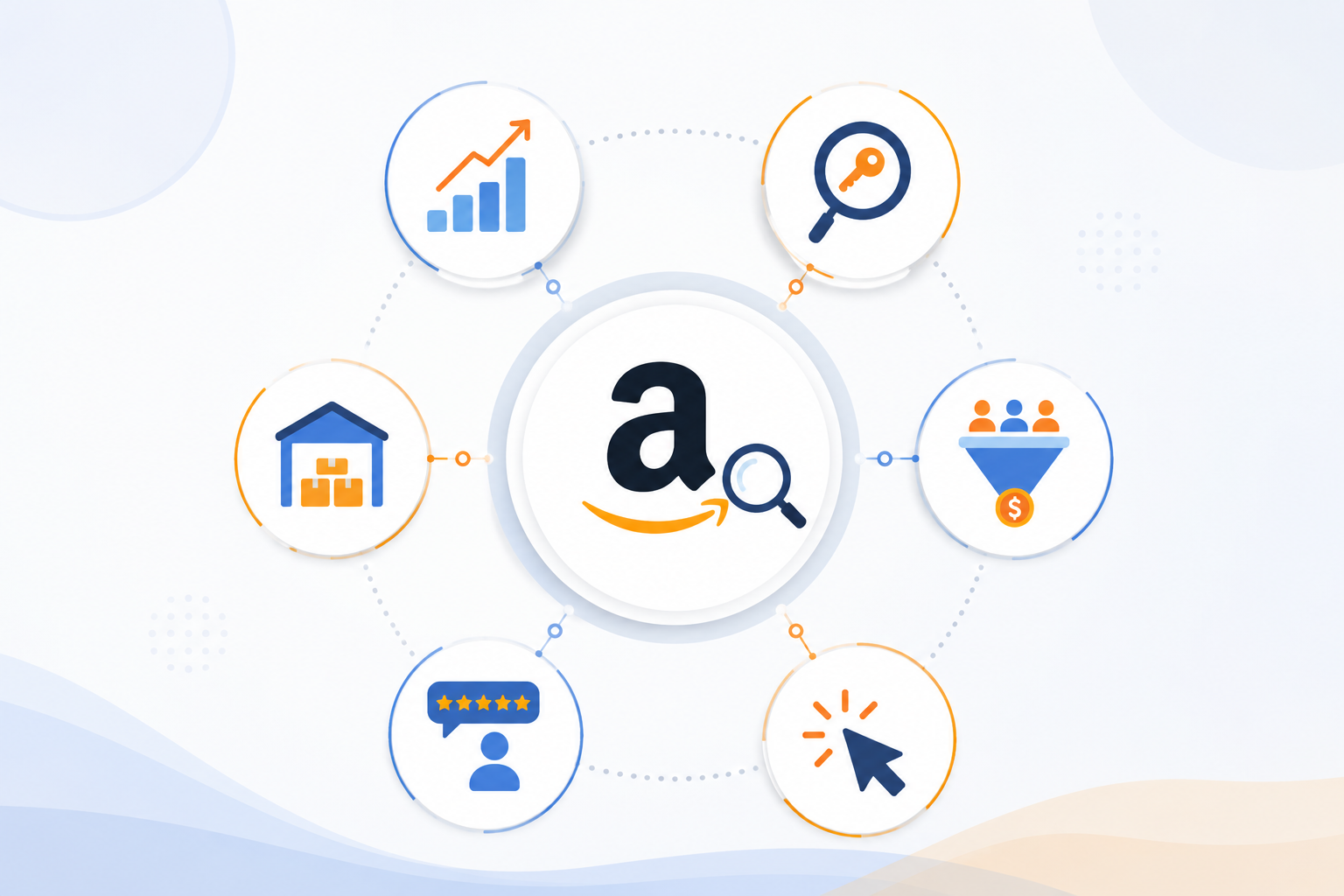
Sales Velocity
Sales velocity, how consistently and frequently your product sells, is the most powerful organic ranking factor on Amazon. The algorithm interprets high, consistent sales as evidence that buyers trust and want your product. A product selling 20 units a day will almost always outrank a comparable product selling 3 units a day, all else being equal. To build strong sales velocity, especially in the early phase:
- Run PPC campaigns from day one to generate immediate keyword-level sales history
- Use launch promotions or limited-time coupons to reduce buyer friction
- Leverage any existing audience email lists and social media to drive early purchases
- Maintain consistent pricing to avoid conversion drops that flatten velocity
Keyword Relevance
Amazon’s algorithm can only rank you for searches where your listing is considered relevant. Keyword relevance is determined by how well your title, bullet points, description, and backend search terms match the language buyers use when searching. If your primary keyword doesn’t appear naturally in your title, Amazon has less confidence that your product is the right result for that query. Common keyword relevance mistakes sellers make:
- Placing the primary keyword only in bullet points instead of leading with it in the title
- Leaving backend search term fields incomplete or filled with duplicates
- Targeting high-volume broad terms while ignoring high-converting long-tail variations
- Failing to update keywords as search trends shift over time
Conversion Rate
Conversion rate, the percentage of shoppers who view your listing and then make a purchase, is a direct signal to Amazon about how well your product meets buyer expectations. A high conversion rate tells the algorithm that your product is delivering on what the search query promised. Everything on your listing influences this:
- Main image quality and clarity against a clean white background
- Price relative to comparable competitors on page one
- Bullet point copy that addresses buyer needs and answers objections
- Review count and average rating are visible on the search results page
- A+ Content that reduces purchase hesitation and tells a compelling brand story
Improving conversion rate is often the fastest lever for improving organic ranking because the changes take effect immediately with each new visitor.
Click-Through Rate
Before a buyer can convert, they have to click. Your click-through rate is influenced primarily by your main image, title, price, and review count. A product with a compelling main image and competitive price will consistently out-click a competitor with a weaker visual presentation, even if the underlying products are similar. Factors that directly impact your CTR:
- Main image professionalism and product fill ratio within the frame
- Title readability does it clearly communicate what the product is at a glance?
- Price competitiveness relative to adjacent listings on the same page
- Star rating and review count visible beneath the title
Reviews, Inventory, and Fulfillment
Customer reviews influence both conversion rate and Amazon’s assessment of your product’s trustworthiness. A listing with 200 reviews averaging 4.5 stars consistently outperforms a listing with 15 reviews at the same rating. To build reviews the right way:
- Enroll in Amazon’s “Request a Review” feature for automated post-purchase prompts
- Focus on product quality and packaging so reviews reflect genuine buyer satisfaction
- Address product issues that appear repeatedly in feedback before they accumulate
Running out of stock is equally damaging. When inventory hits zero, Amazon stops displaying your product prominently, and the ranking you earned through consistent sales disappears. Set reorder trigger points well above zero, account for FBA check-in delays, and build a 30-day safety buffer for your fastest-moving products. FBA products also rank better than FBM equivalents in most cases. Prime eligibility increases conversion rate significantly, and the algorithm reflects that advantage directly.
How to Rank Organically on Amazon: Step-by-Step

Step 1: Build a Keyword Foundation That Matches Real Buyer Searches
Start with thorough keyword research before writing a single word of your listing. Identify your primary keyword and build a supporting list of secondary and long-tail terms that capture how different buyers describe the same need.
- Use tools like Helium 10, Jungle Scout, or DataDive to find real search volume and competition data
- Study top-ranking competitor titles and bullets to identify keyword patterns
- Prioritize buyer-intent terms over broad informational searches
- Map each keyword to the right field: primary in the title, secondary in bullets and description, remainder in backend fields
A seller I worked with, Raj, launched a resistance band set targeting only broad fitness keywords initially. After mapping 45 buyer-intent terms, things like “resistance bands for physical therapy” and “light resistance bands for seniors,” his listing appeared in niche searches competitors weren’t targeting. Those niches converted at nearly double the rate of the broad terms and built his organic ranking faster than he expected.
Step 2: Optimize Your Listing for Both Amazon and Buyers
Your listing has to serve two audiences simultaneously: Amazon’s algorithm, which reads keyword placement and relevance signals, and real human buyers, who make decisions based on images, copy quality, and perceived value. Optimizing for one while ignoring the other creates listings that either rank but don’t convert, or convert well but never get seen.
Write a title that leads with your primary keyword and communicates key product differentiators clearly. Bullet points should be benefit-driven, explaining how each feature improves the buyer’s experience rather than just listing specifications. Key listing elements to audit before going live:
- Title: primary keyword first, key attributes included, fully readable without truncation
- Bullets: benefit-led, specific, addressing the top five buyer concerns or desires
- Description / A+ Content: brand story, lifestyle context, objection handling
- Backend search terms: filled with non-duplicate keyword variations
- Images: main on white background, lifestyle shots, infographic with key specs
Step 3: Use PPC to Build Organic Momentum
Every sale your ads generate on a specific keyword builds sales history for that keyword, which feeds directly into your organic ranking for the same term. Your early PPC investment isn’t just buying short-term visibility; it’s laying the foundation for long-term organic position. A smart PPC-to-organic transition looks like this:
- Weeks 1–2: Run broad automatic campaigns to collect search term data
- Weeks 3–4: Build manual exact and phrase campaigns around converting terms
- Month 2: Reduce auto bids, increase manual campaign budgets on proven keywords
- Month 3+: Scale back PPC on organically ranking terms and reinvest in new targets
Step 4: Drive Sales Velocity Through Every Legitimate Channel
Amazon rewards consistent sales, and consistent sales come from more than just on-platform traffic. Driving external traffic from social media, email lists, and influencer partnerships sends buyers directly to your listing. Amazon’s algorithm gives additional ranking credit for external traffic because it signals your product has appeal beyond the Amazon ecosystem. External traffic sources worth activating:
- Email lists announcing new products or limited-time promotions
- Social media posts on Instagram, Pinterest, or Facebook targeting relevant communities
- Micro-influencer partnerships in niche audiences are already interested in your product category
- Blog content or YouTube reviews that organically drive search traffic to your listing
Step 5: Monitor and Protect Your Organic Ranking
Ranking is earned continuously, not once. Track your keyword ranking positions weekly, monitor conversion rate, and flag sudden drops quickly. A competitor pricing change, a new negative review, or a listing quality issue can erode conversion and pull your ranking down fast. Regular maintenance tasks that protect organic ranking:
- Weekly keyword rank checks for primary and top secondary terms
- Monthly PPC search term report reviews for new organic keyword opportunities
- Quarterly backend keyword updates to incorporate new search trends
- Ongoing monitoring of competitor pricing and listing changes in your niche
Improve Amazon Organic Ranking: Quick Wins That Work
Many sellers focus only on major strategic moves and overlook high-impact adjustments that can improve Amazon search ranking quickly. Improving your main product image is one of the fastest conversion lifts available. Updating your title to include a missed high-volume keyword takes minutes and can open ranking opportunities that were previously invisible. Other quick wins worth acting on immediately:
- Fill all backend search term fields. Many sellers leave these partially empty
- Add an infographic image highlighting your top three product benefits to boost conversion
- Reduce price slightly during a competitive ranking window to tip conversion rate in your favor
- Respond to recent negative reviews professionally to minimize their impact on the star rating
- Enable A+ Content if the Brand Registered it consistently improves conversion and dwell time
How Dragon Dealz AMZ Igniter Helps You Build Organic Ranking Faster

Building organic ranking on Amazon requires the right keyword foundation, a listing that converts, sustained sales velocity, and consistent performance monitoring, all running simultaneously. For sellers managing products, sourcing, and customer service at the same time, executing every element of an Amazon SEO ranking strategy at the required depth is genuinely difficult to do alone.
Dragon Dealz’s AMZ Igniter service
It is built specifically to help sellers establish and grow their Amazon organic ranking through expert-led strategy and execution. From deep keyword research and listing optimization to PPC-driven velocity building and ongoing rank monitoring, AMZ Igniter covers the full organic ranking cycle so your product gains the visibility and sales momentum it needs to compete at the top of page one. Whether you’re launching a new product or breaking through a ranking plateau on an existing listing, a structured, data-driven approach is the difference between slow progress and real, measurable results.
Conclusion: Organic Ranking Is the Long Game Worth Playing
Understanding what organic ranking on Amazon means is the first step, but acting on that understanding is what separates sellers who stay dependent on ads from those who build sustainably profitable businesses. Every listing optimization, every sale that builds your velocity, and every satisfied customer who leaves a review is an investment in an organic position that compounds over time. Start with your keyword foundation, build a listing that converts real buyers, back it with smart PPC during your launch window, and treat your organic ranking as something you actively manage rather than passively hope for.
FAQs
What is organic ranking
It’s your product’s natural position in Amazon search results for a keyword earned through sales, relevance, and conversion performance rather than paid advertising.
Most new products begin showing meaningful organic movement within 30–90 days of consistent sales velocity, strong listings, and active PPC support.
Sales velocity, conversion rate, keyword relevance, click-through rate, reviews, inventory availability, and fulfillment method are the core factors the algorithm evaluates.
Yes. PPC-driven sales build keyword-level sales history that directly feeds your organic ranking for those same search terms over time.
Start with listing optimization, better images, benefit-driven copy, and complete keyword coverage combined with PPC to build early sales velocity.